Pre-alpha · protocol first, product later

Many gateways.
One substrate.
Media that outlives its platforms.

Evermesh splits media — video and music — into a small, permanent substrate — signed records and content-addressed blobs that verify from their own bytes — and a competitive edge of gateways, nodes, and viewers that decides everything contested: moderation, discovery, monetization. No servers of record. No token. No company you have to trust, including ours.

  • Video
  • Music & playlists
  • Desktop client
  • Web player

Experimental — not production-ready Optionally built on DMTAP-PUB §22

01 / the test

The survival test

Every design decision in Evermesh answers one question: does the network still work after every organization involved dies or betrays it?

Not "is it federated". Not "is it open source". Those are means. The test is whether a video or a track published today is still playable, still attributable, and still re-hostable when the gateway that served it, the foundation that wrote this spec, and the operators who ran the relays are all gone.

The gateway shuts down

Your videos were never in it

A gateway is an index and a cache with a domain name and a legal posture. It holds a selection of the substrate, not the original of anything.

Still works The records and blobs are just as valid on any other gateway that chooses to index them, and any node that pinned the blobs can re-seed them. Nothing needs to be migrated, because nothing was ever owned.

The foundation dies

It operated nothing to lose

The steward publishes a spec, a kind registry, and a conformance suite. It runs no servers, holds no keys, and has no ability to revoke, delist, or authorize anyone.

Still works A frozen spec is a working spec. The registry is a file you can fork; the conformance suite is 189 vectors you can replay. The two-implementations rule exists so nothing in the protocol depends on one group's code surviving.

The network splits

There was no consensus to lose

No chain, no global ordering, no quorum, no firehose everyone must reach. Records are signed and content-addressed, which is enough to verify them alone in a room.

Still works Both sides of a partition keep publishing and keep verifying. Offline bundles move content across an air gap on a disk. When the link comes back, the two halves merge — there is nothing to reconcile because nothing was ever a vote.

A protocol that needs its authors to stay alive is a product with extra steps.

02 / mechanics

How it works

Three layers, and only the middle one is permanent. The kernel names no transport, no company, and no chain — it defines bytes that carry their own proof.

Layer 1 — publish

A record is signed bytes

A creator's key signs a canonical CBOR envelope. Media itself lives in blobs addressed by BLAKE3 chunk trees, so a byte range can be proven without fetching the file.

  • Ed25519 signatures, canonical encoding, stable ids
  • Identity is a rotation log, not an account
  • 27 record kinds: manifests, claims, comments, live, more

Layer 2 — carry

Relays move records; nobody owns them

Relays accept, store, and forward records over a websocket sync protocol with filtered subscriptions, proof-of-work anti-spam, and retention policy. Losing one costs you nothing.

  • Subscribe to what you care about, not to everything
  • Blob sidecar serves ranges and chunk proofs over HTTP
  • Offline bundles carry the same records with no network

Layer 3 — serve

Gateways compete on judgement

A gateway indexes its own selection, sets its own moderation policy, answers to its own jurisdiction, and competes on search, transcoding, community and payment.

  • The substrate never deletes; gateways decline to serve
  • Takedown feeds are plural, signed, and subscribable
  • Viewers verify client-side — trust the math, not the host
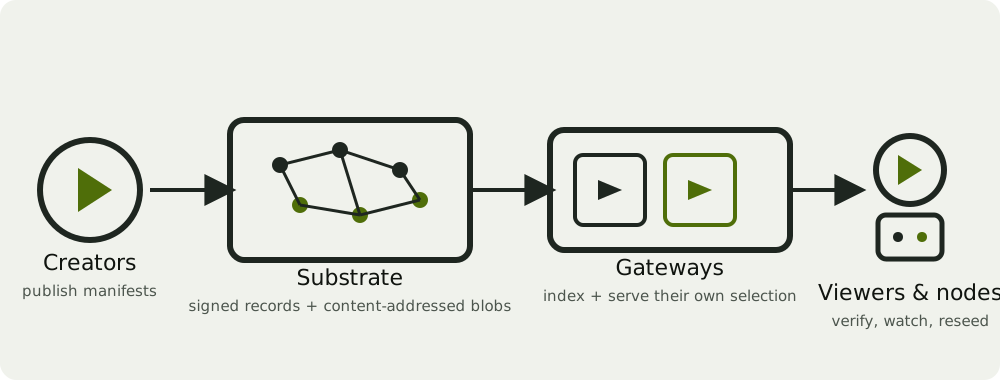
Creators publish signed manifests into a substrate of records and content-addressed blobs; independent gateways index and serve their own selection of it; viewers and nodes verify signatures and hashes and re-seed the blobs.
03 / participation

Three ways to take part

Participation is a ladder. Every rung is optional, useful on its own, and reversible — you can stop being a node on Tuesday and still be a viewer on Wednesday.

  1. 01

    Viewer

    runs: a browser

    Watches or listens. Verifies signatures and hashes client-side while the video or track plays, so a hostile or careless gateway cannot quietly substitute different bytes. No account, no setup, no commitment.

  2. 02

    Node

    runs: a background app

    Pins what you choose — your own videos first, subscriptions second — and re-seeds it to others inside budgets you set. This is the rung that makes "outlives its platforms" literally true. No public-facing duties, no domain, no legal exposure.

  3. 03

    Gateway

    runs: a public website

    An independent site on its own domain that indexes and serves its own selection of the substrate, under its own moderation policy and its own jurisdiction. Gateways are where the contested decisions live, on purpose, so that the substrate never has to make them.

A creator is not a separate piece of infrastructure — it is any keyholder who publishes a video or audio manifest, and creators may run a node and a gateway too. A foundation stewards the spec, the registries, and the conformance suite, and runs no servers of its own.

04 / honesty

What actually exists

A page like this usually describes software that does not exist yet. Here is the line between what runs today and what is only written down. It mirrors the repository README exactly, and it is meant to be uncomfortable while it is still true.

Evermesh is pre-alpha. There is no deployment, no public gateway, and no app you can install. What exists is a normative spec, a protocol kernel, a relay, a reference gateway, and a conformance suite whose tests pass. Where code and spec disagree, the spec wins.

Component status

PathWhat it isState
spec/ Normative protocol spec (000–011 + IETF draft) Complete for v1
evermesh-kernel Records, identity rotation, blobs and chunk proofs, bundles, all 27 kinds Implemented, tested
evermesh-relay Sync websocket, storage, subscriptions, gossip, PoW, retention, blob sidecar Implemented, tested
evermesh-wasm / kernel-ts WASM bindings and the typed TS API over them Implemented, tested
gateway/server Index, policy engine, key custody, ingest, upload, JSON API Implemented, tested
gateway/web The uniform reference UI: video & audio player, playlists, verification, channels, upload Implemented, tested
tools/conformance 189 deterministic vectors replayed against three runtimes Green
swarm / P2P WebRTC / BitTorrent-style retrieval described in the spec Spec only — not built
live streaming live.manifest / live.chat kinds validate in the kernel Spec only — no ingest, no player
non-custodial keys Client-held keys; the reference gateway custodies keys server-side today Later phase
evermesh-node Desktop client (Tauri 2) — browses a gateway, verifies manifests natively, pins video and audio for offline playback Implemented, tested
node seeding / swarm The desktop client pins and caches for its own owner but does not seed to other nodes yet No P2P transport

Conformance: the golden rule

The same vectors are replayed against three independent runtimes — the Rust kernel in-process, the WASM kernel under Node, and a live relay over its websocket. A vector must pass identically in every runtime; a divergence is a protocol bug, never a fixture to special-case. The differing counts are documented per-runtime skips — each runtime only checks what it is responsible for.

Conformance matrix

Target Pass Fail Skip
kernel18900
node (WASM / kernel-ts)142047
relay (/sync)115074
05 / the spec

Twelve files, one concern each

Cross-referenced, self-consistent, and boring on purpose, so a stranger can reimplement the whole thing from the text alone. Read them in the docs viewer or in the repository.

  1. 000-overviewprinciples, roles, and the map of the spec
  2. 001-kernelrecord envelope, canonical CBOR, ids, algorithm registry, blobs, chunk trees
  3. 002-identityrotation log, recovery precedence, delegation, profiles
  4. 003-kinds-registrythe numeric registry of record kinds and their schemas
  5. 004-manifestvideo manifests, renditions, deduplication, live streams
  6. 005-claimsauthorship and license claims, disputes, provenance
  7. 006-relayrelay sync protocol, blob sidecar, anti-spam, gossip
  8. 007-bundlesthe offline bundle container format and partition posture
  9. 008-privacyencryption modes, key grants, metadata privacy
  10. 009-gatewaygateway selection, compliance, legal toolkit, the uniform reference UI
  11. 010-economicspayment pointers, receipts, disclosures
  12. 011-threat-modeladversaries, attack surfaces, mitigations, residual risk
  13. IETF draftthe same protocol as an Internet-Draft
06 / objections

Reasonable objections

Most of these have been asked in bad faith at some point. They are all still worth answering.

How is this different from PeerTube, Nostr, or Bluesky?

PeerTube federates independent servers, but each server still owns the identity and data of its own users — moving off one means starting over. Evermesh keeps identity and content self-certifying and portable; gateways select and serve rather than own.

Nostr shares the substrate spirit — signed events distributed through relays you choose. Evermesh is built specifically for media on top of that idea: native manifests, renditions, authorship claims, and offline bundles that a plain event feed does not define.

Bluesky / AT Protocol also uses rotation-based portable identity, similar in spirit to Evermesh's identity log. The difference is that Evermesh has no required global relay or app-view: every gateway builds its own view from scratch, and the protocol is designed to keep working partitioned, not just when everyone can reach a central firehose.

Is there a token?

No, permanently. The spec carries optional payment primitives so creators and gateways can charge for things if they want to, but it takes no position on business models, and no protocol token exists or will exist.

Is this a blockchain?

No. No chain, no mining, no global consensus of any kind. Records are signed and content-addressed, which is enough to make them independently verifiable — and that verification never depends on everyone agreeing on a shared ledger.

So anything can be published and nothing can be removed?

The substrate does not delete, and pretending otherwise would be a lie. Removal happens where it can actually be enforced: at the gateway that chooses to serve, in the jurisdiction it operates in. The reference gateway ships a policy engine, signed and subscribable takedown feeds, geo-blocking, and a legal toolkit — because moderation is a real operational job, not a protocol keyword.

Who is in charge?

No one operationally. A foundation stewards the spec, the kind registry, and the conformance suite; it runs no servers and holds no user data. The design goal is that the network keeps working after the foundation is gone — see the survival test above.

Is Evermesh converging with another protocol?

Re-basing the substrate on a shared publish/subscribe layer (DMTAP §24) is under decision and has not been adopted. The analysis is public in DMTAP convergence and the reasoning log in DECISIONS. Until it is decided, the spec in this repository is the protocol.